The Doge's Palace
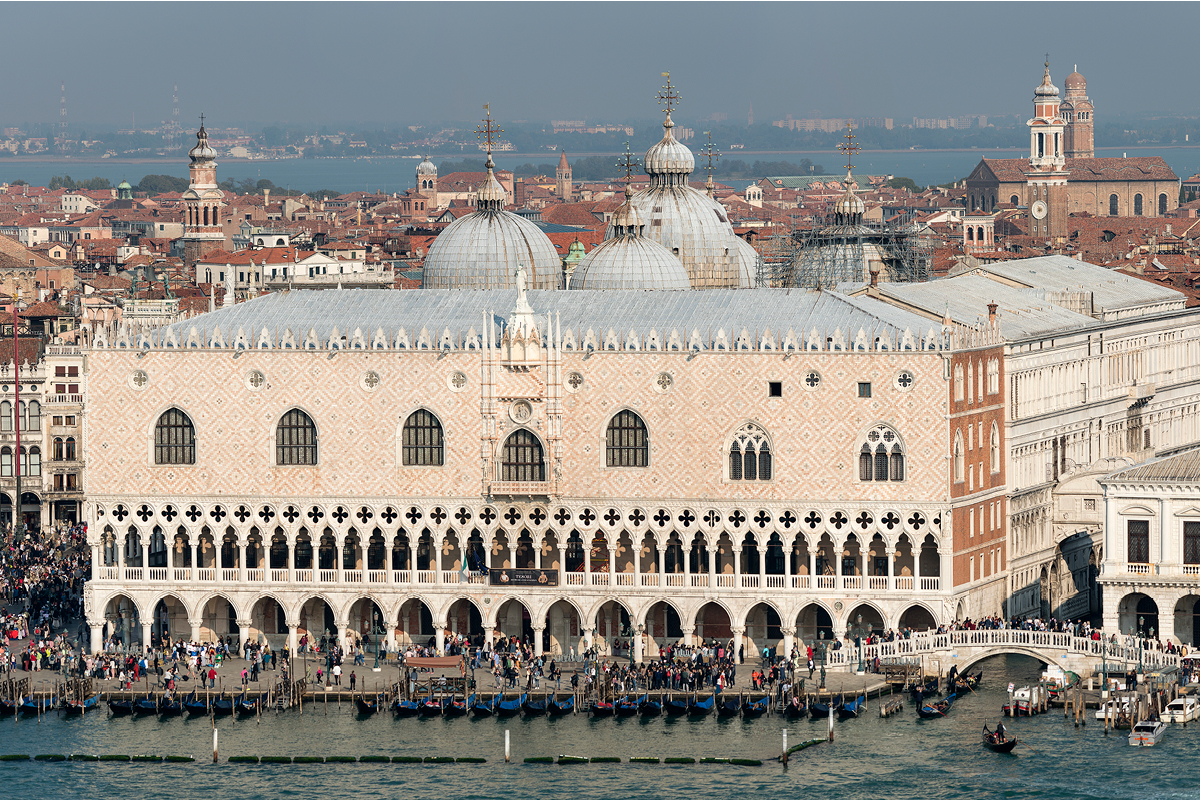
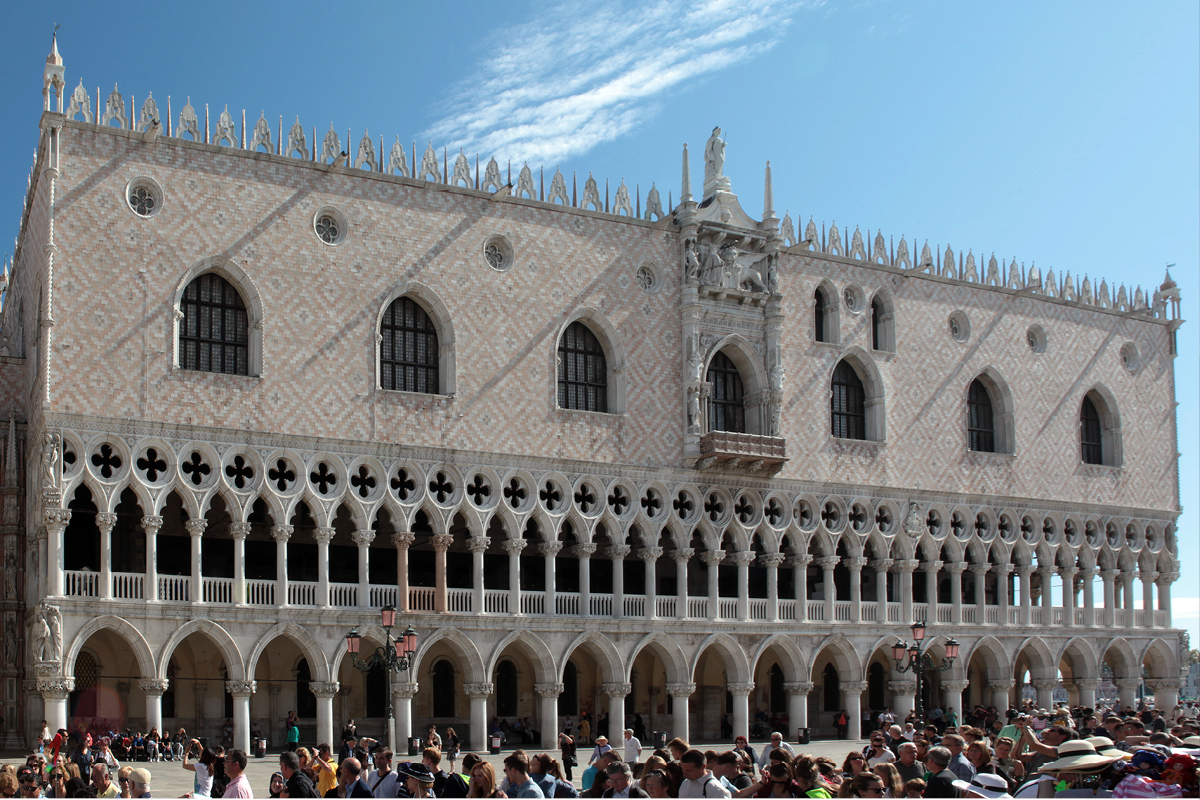
A masterpiece of Gothic art, the Doge's Palace is a symbol of Venice's history and the former residence of the Doge. Its unique structure combines Gothic, Renaissance, and Mannerist elements, creating a harmonious blend of architectural styles that reflect the evolution of Venetian art and culture over the centuries.
The palace is composed of three large blocks: the wing towards St. Mark's Basin was rebuilt from 1340; the wing towards St. Mark's Square was built from 1424; and the canal-side wing, containing the Doge's apartments and government offices, dates from 1483-1565. The Porta del Frumento serves as the main entrance for visitors, welcoming them into this historic monument that has witnessed the political and cultural life of the Venetian Republic.
The origins
The origins of the Doge's Palace date back to the 9th century, when Venice was beginning to establish itself as an autonomous center. Over the centuries, the building underwent numerous expansions and renovations.
In the 10th century, the Old Castle was built: the area now occupied by the palace likely consisted of an agglomeration of different buildings destined to serve various purposes, protected and enclosed by a substantial wall.
In the 12th century, Doge Ziani replaced the old structure with a new building open to the city, composed of two new wings: one facing the Piazzetta, intended to house courts and legal institutions, and the other overlooking St. Mark's Basin, to house government institutions.
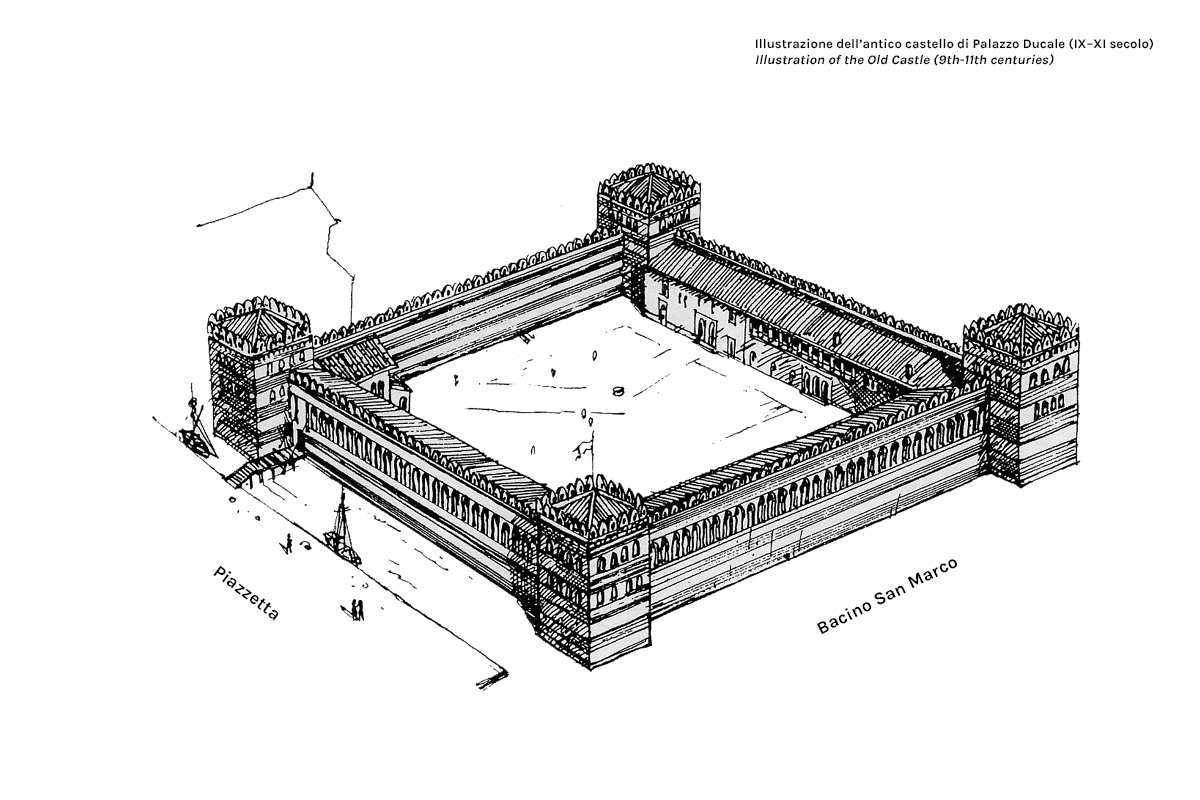
Illustration of the Old Castle (9th-11th centuries)
14th century
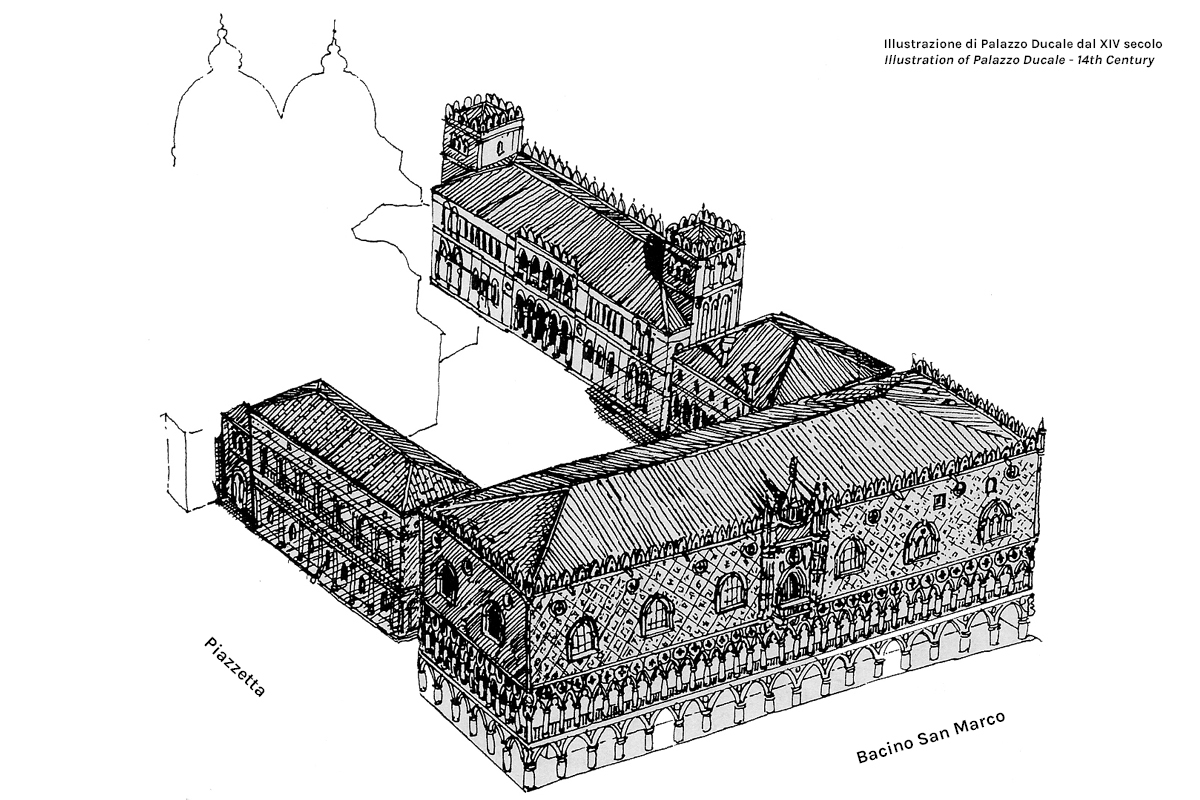
14th century reconstruction
During the 14th century, the palace was renovated on the side facing the lagoon. The renewal continued into the 15th century, particularly on the wing facing the Piazzetta, under the direction of Doge Francesco Foscari.
After a fire in 1483, the palace was rebuilt and further expanded, introducing the new Renaissance architectural language to the building.
Subsequent fires in 1574 and 1577 damaged parts of the structure and its decorative elements, but the restorations preserved the original appearance of the architecture.
Up to the Present Day
In the 17th century, the New Prisons were built and connected to the palace by the famous Bridge of Sighs.
After the fall of the Republic of Venice in 1797, the Doge's Palace housed important cultural institutions such as the Biblioteca Marciana (from 1811 to 1904). In the following years, a major restoration project preserved its historical appearance.
In 1923, the Italian State, owner of the building, appointed the City Council to manage it as a public museum. In 1996, the Doge's Palace became part of the Civic Museums of Venice network.
A symbol and the very heart of the political and administrative life of the Venetian Republic's thousand-year history, it is visited every year by millions of people who come to explore its history and admire its architecture and artistic treasures.
The Doge
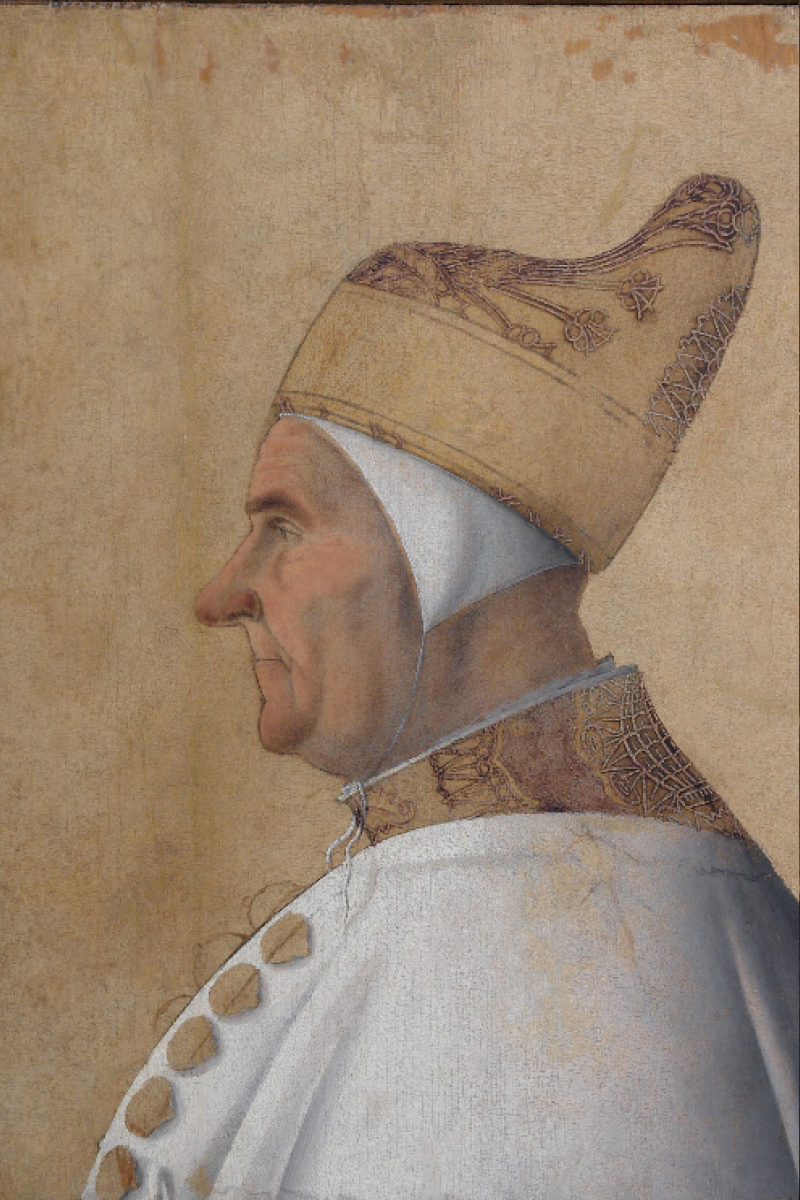
The Doge was the oldest and highest political position in the Venetian Republic. The word comes from the Latin dux, which means leader and was the title given to the governors of provinces in the Byzantine Empire, of which the Venice lagoon was a part in the 7th and 8th centuries, when documentation of the first doges is to be found.
Over the centuries, the Doge gained power, with an elective position that, amid hereditary successions, conflicts, and violent deaths, became stable in the 8th century. Starting in the 11th century, as Venice had become independent of Byzantium, his powers were limited: he was supported by councillors and bound by the Promissione, a set of rules that regulated both his public and private life.
The Doge
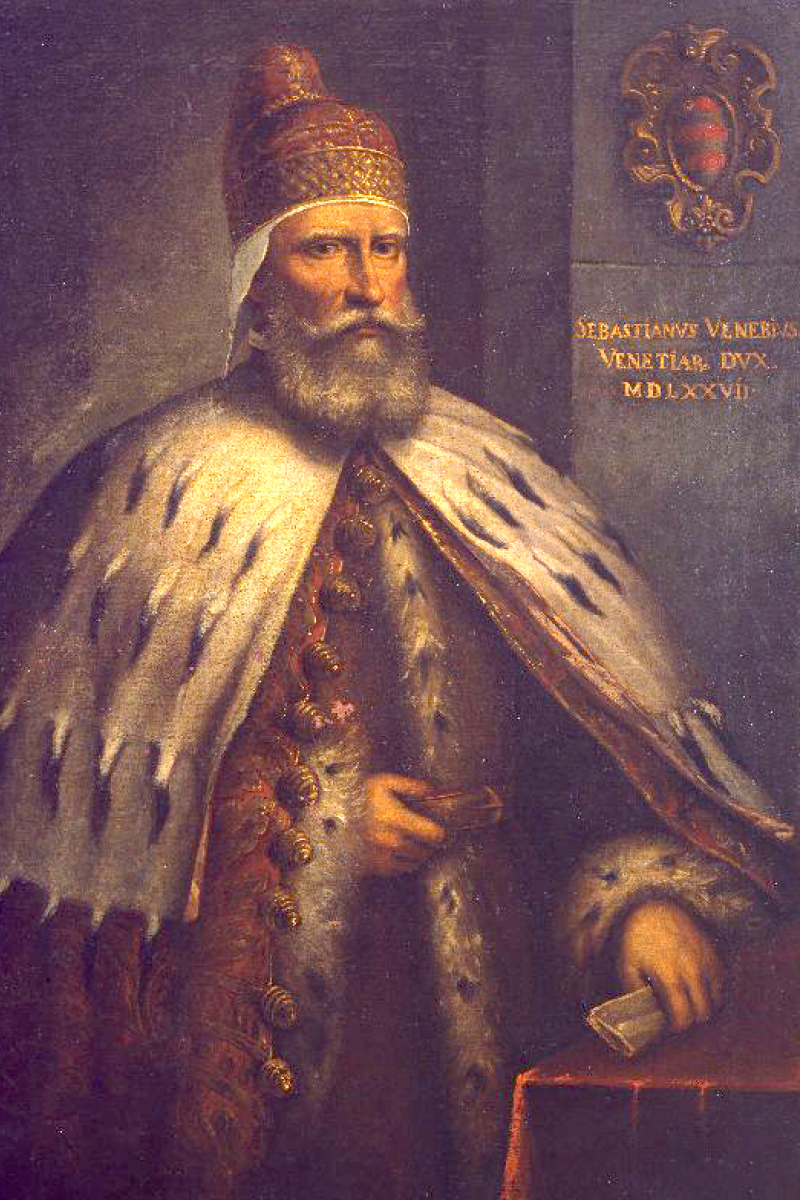
Elected by means of a very complicated voting procedure by the Great Council, the Doge was the only Venetian authority to hold office for life. Although he embodied the supreme representation of the Republic with countless and highly significant symbolic functions, he held no executive, legislative or decision-making power and was required to follow a strict ceremonial protocol.
At his death, solemn funeral rites were foreseen but the city was not in mourning, "because the Republic never dies". His successor was nominated very rapidly with a solemn ceremony of investiture. The last doge was Ludovico Manin, who abdicated in 1797 when Napoleon Bonaparte's soldiers entered Venice, thus marking the end of the ancient Republic.
Visitor itineraries
The suggested tour route does not follow the floors of the Palace in a linear sequence, but instead outlines an itinerary that goes up and down, crossing them multiple times.
From the ground floor, where visitor services are located, the tour begins with the Museo dell'Opera, passing through the extraordinary courtyard, continues toward the Loggia on the first floor (where the Doge's Apartments are located) and then to the Institutional Chambers, throughout the first and second floors.
The visit finishes with the Armoury, the Picture Gallery and the Prisons.
There are also the Secret Itineraries and the Doge's Hidden Treasures, which are not part of the regular tour of the Palace, but are special routes that can only be visited under specific conditions.
Museo dell'Opera
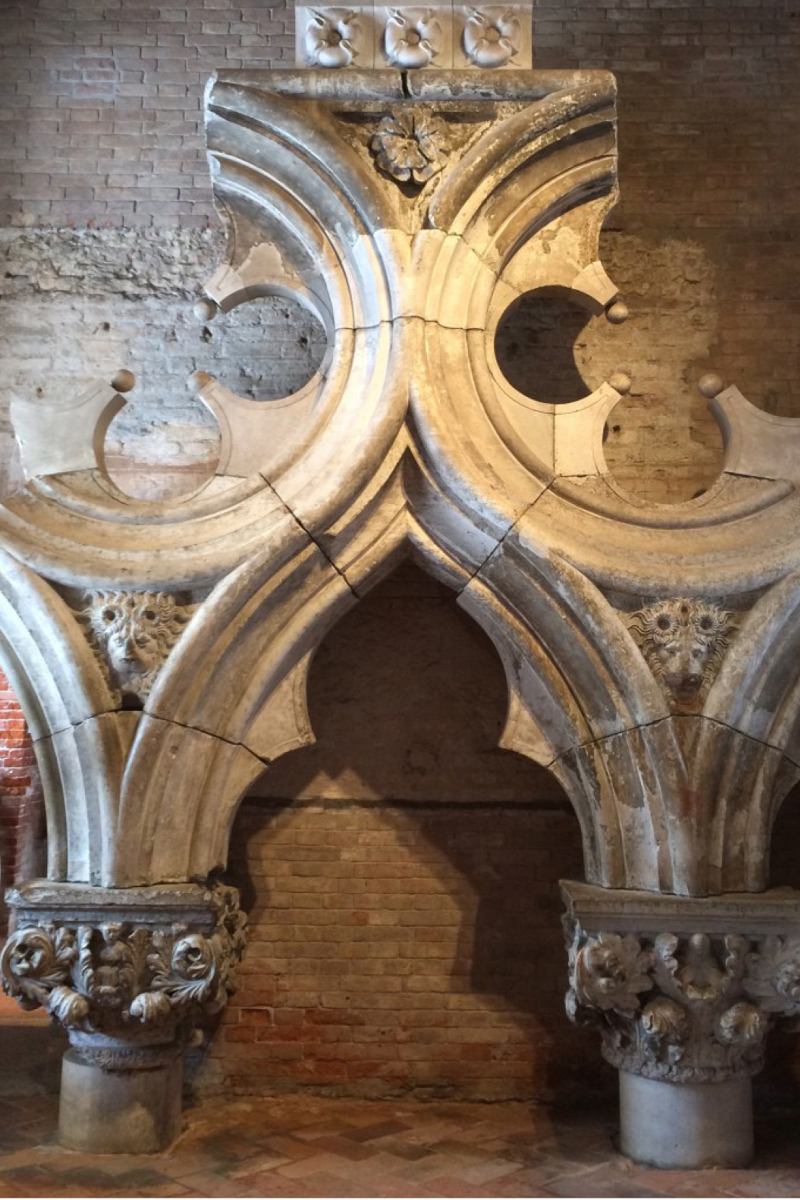
After the mid-19th century, the Palace seemed to be in such a state of decay that its very survival was in question; thus from 1876 a major restoration plan was launched. The work involved the two facades and the capitals belonging to the ground-floor arcade and the upper loggia: 42 of these, which appeared to be in a specially dilapidated state, were removed and replaced by copies. The originals, some of which were masterpieces of Venetian sculpture of the 14th and 15th centuries, were placed, together with other sculptures from the facades, in an area specifically set aside for this purpose: the Museo dell'Opera.
After undergoing thorough and careful restoration works, they are now exhibited, on their original columns, in these 6 rooms of the museum, which are traversed by an ancient wall in great blocks of stone, a remnant of an earlier version of the Palace.
Courtyard and the Loggias
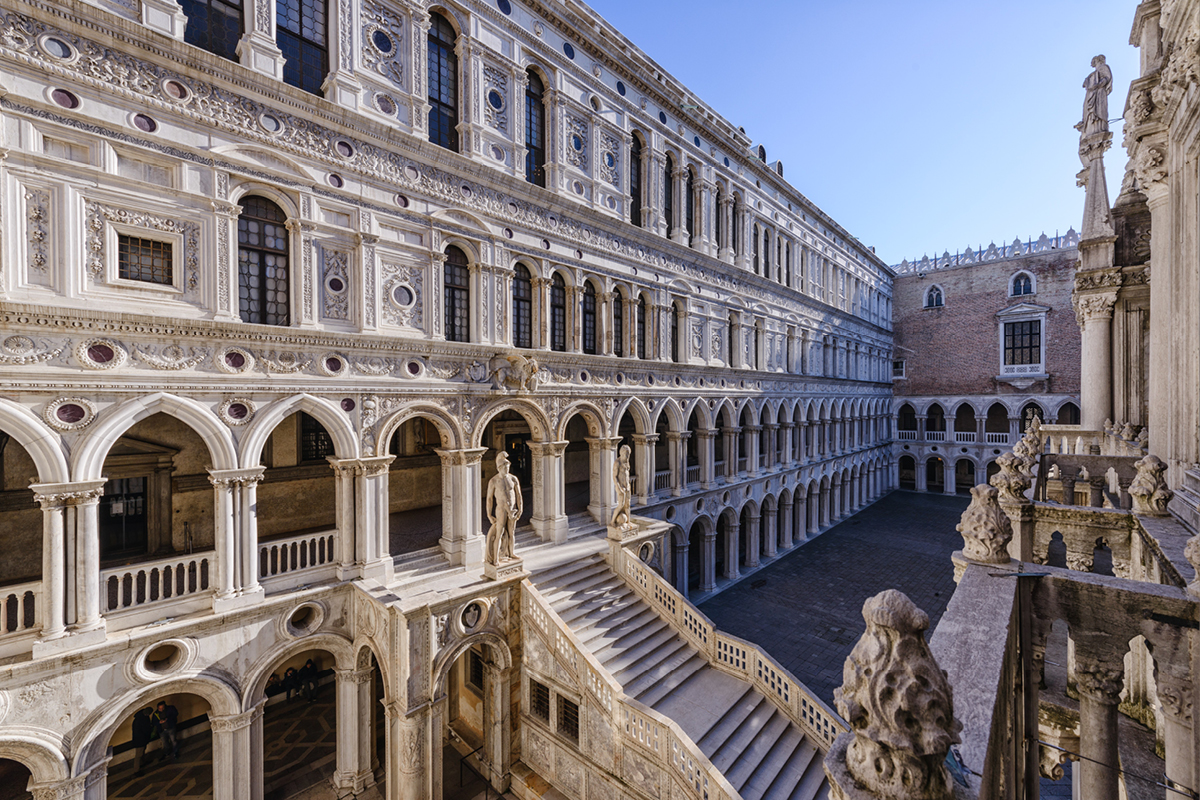
The courtyard offers a view of the two oldest wings of the Palace—more austere and simple in style—and the Renaissance wing, which features richer decoration and culminates, at the far end, with the Giants' Staircase, the ancient formal entrance. At its top stand two colossal statues of Mars and Neptune, sculpted by Sansovino in 1565. The staircase, designed by Antonio Rizzo, stands next to the arch dedicated to Doge Francesco Foscari (1423–1457), which links the Giants' Staircase to the Porta della Carta through which visitors today leave the palace
The loggia level allows visitors to walk along the eastern, southern, and western wings of the Palace, offering striking views over the courtyard and Piazzetta San Marco. From here, the tour continues, from the Censors' Staircase to the Gold Staircase, leading you to the upper floors, passing through the Renaissance wing. Along this route are several embedded "bocche di leone" (lion's mouths), where, starting from the late 16th century, anonymous denunciations of crimes or corruption could be submitted.
Institutional Chambers
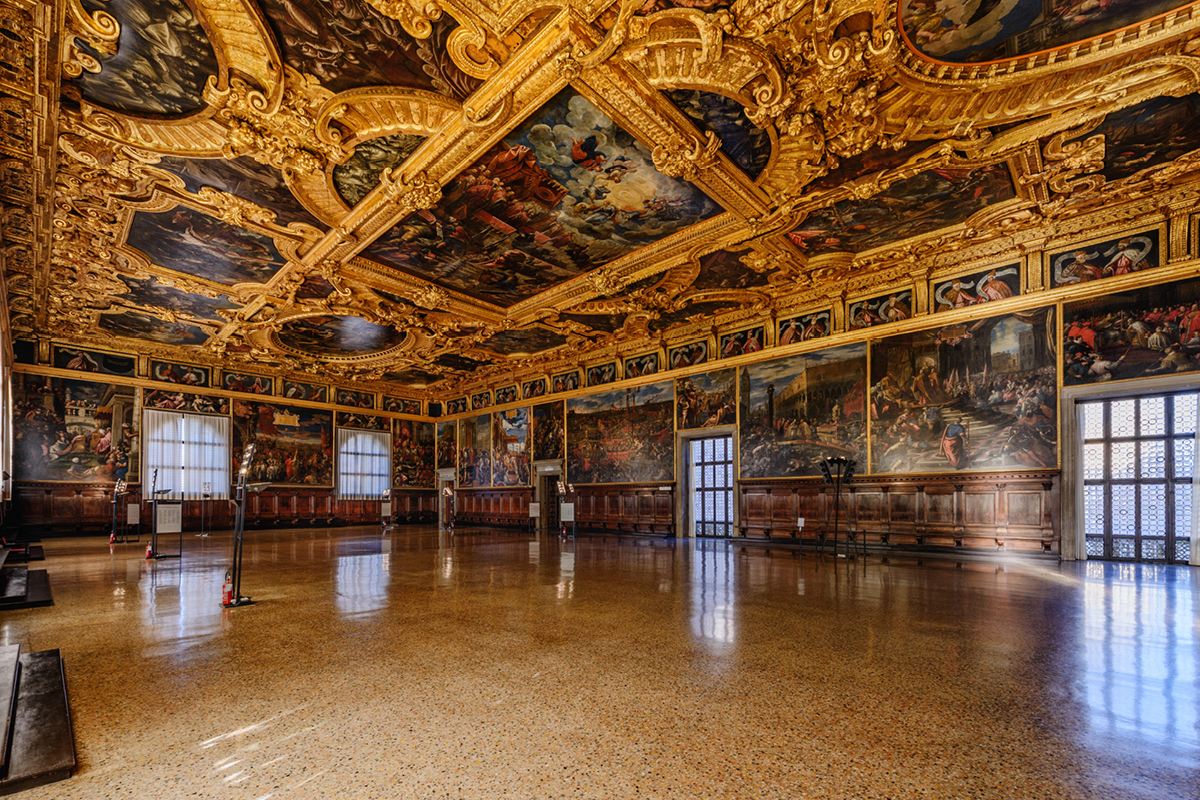
The tour through the various Institutional Chambers in the Palace begins in the Square Atrium. These were the rooms which housed the organs of a political and judicial administrative which was the envy of Europe for centuries, due not only to its immutability (in spite of the absence of a written constitution) but also to its ability to resist the passage of time and still maintain social peace and harmony.
You will pass through the chambers of all the main organs of government – the Great Council, the Senate and the Collegio – and also visit those used by the main judicial bodies within the Venetian Republic, from the Council of Ten to the so-called Quarantie (Councils of Forty).
In all of the rooms, the decor is carefully chosen and designed not only to indicate the role of the bodies who met within them, but also to celebrate the virtues of the State.
The Picture Gallery
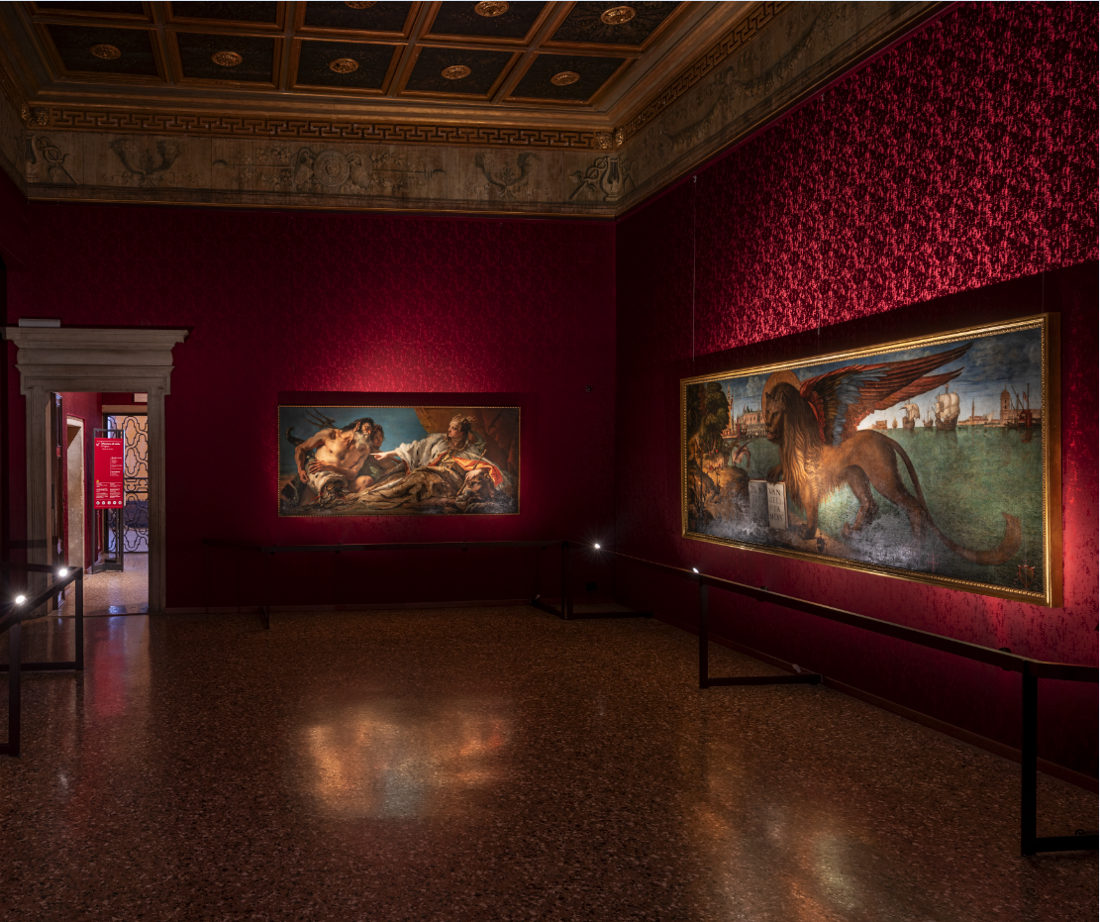
The current rearrangement of the Sala della Quarantia Criminale, Sala dei Cuoi and Sala del Magistrato alle Leggi fits into this tradition together with "institutional" decorative apparatus and other easel paintings from private collections.
In reference to the secular presence of Flemish paintings in the Palazzo, it has been decided to show in the Sala dei Cuoi some Flemish works, among which there is the only survivor of those offered for public use from 1615: The Apocalyptic vision already attributed to Civetta and today more appropriately attributed to an anonymous follower of Bosch.
In the other rooms are exhibited masterpieces by Giovanni Bellini, Carpaccio, Titian and Giambattista Tiepolo, absolute masters of Venetian art.
Prisons
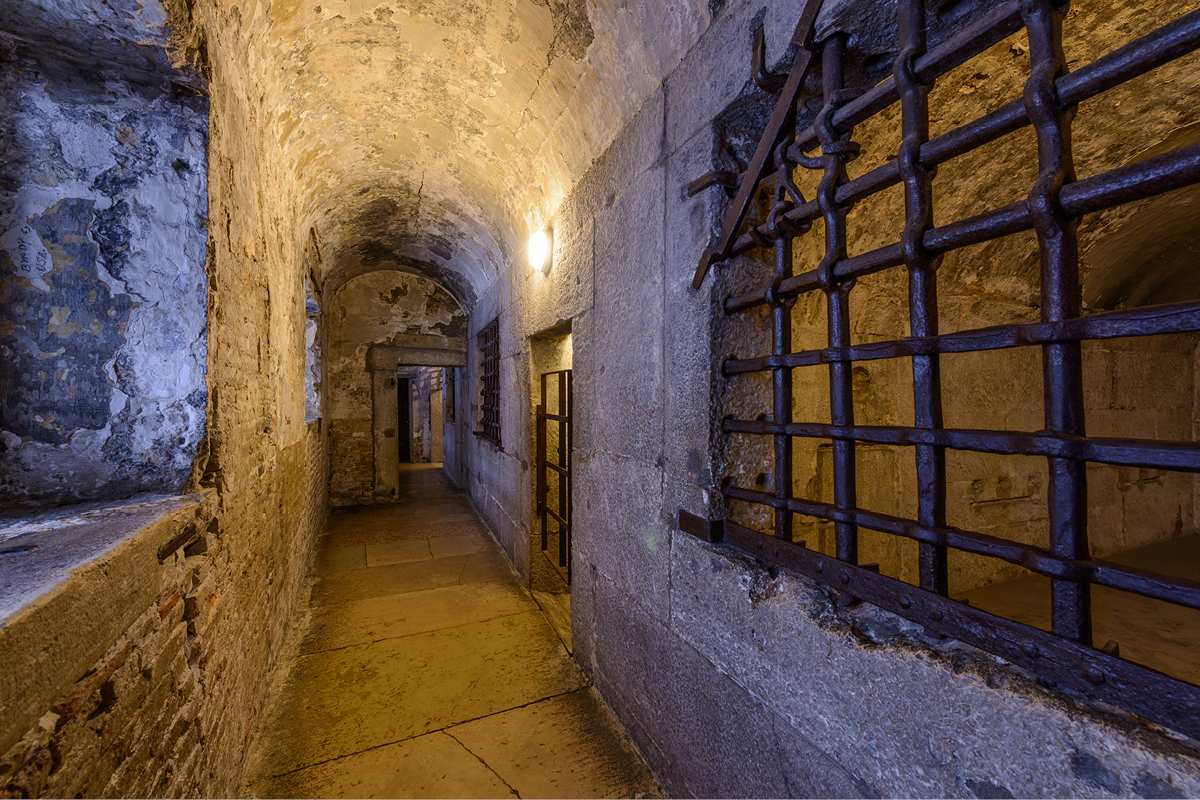
The visit to the Prisons begins with a small descending staircase leading from the Sala del Magistrato alle Leggi into a narrow corridor, one of the two passageways of the famous Bridge of Sighs.
From the bridge, visitors enter the New Prisons, a 16th-century building designed for incarceration, complete with rooms for magistrates. Built on the other side of the canal to the side of the Palace, the structure was intended to improve the conditions for prisoners with larger and more light-filled and airy cells.
For its time, the New Prisons represented one of the earliest, if not the very first, examples in Europe of a standalone, purpose-built state prison designed as a single-use block structure.
Armoury
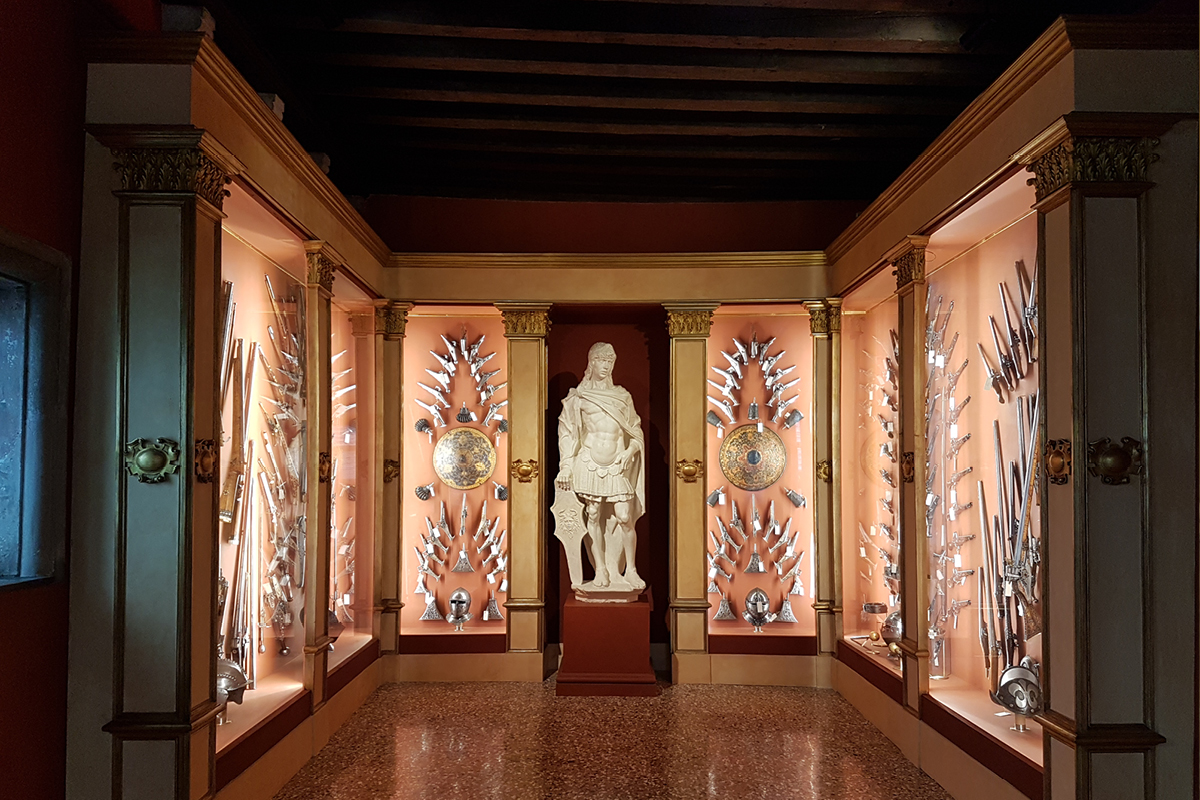
The rooms of the Armoury contain a valuable historical collection of weapons and armaments from several sources. The core of the collection is already documented as existing in the 14th century; and at the time of the Republic the Armoury, under the control of the Council of Ten, was stocked with weapons that would be readily available for the Palace's guards.
On particularly delicate or important occasions, these guards might be joined by the arsenalotti, the highly-trained workforce from the shipyards of the Arsenale (e.g. when a Doge died, all the gates to the Palace were sealed and placed under the guard of the arsenalotti).
Comprising various valuable pieces, the collection of arms was partially dispersed after the fall of the Republic, but it still contains over 2000 exhibits.
Special itineraries
Not included in the standard visitor route, the Doge's Palace offers two special itineraries, available by reservation only and for a limited number of visitors, accompanied by a specialized guide.
The "Secret Itineraries Tour" lead through rooms where, during the centuries of the Serenissima Republic, delicate and important activities took place, tied to the Venetian administration and the exercise of power and justice.
The "Hidden Doge's Treasures Tour" is a fascinating and unusual tour, at times offering panoramic views, through the Doge's private rooms in the wing of the Palace adjacent to the Basilica. The heart of the itinerary is the evocative rooms of the Chiesetta and Antichiesetta del Doge.